3 Ways to Turn Transactional Grantmaking into Transformational Grantmaking

While serving each unique client, Benevolent Vision asks – How can we support a transition from transactional relationships to mutually beneficial, long-lasting, transformational relationships?

Relationships between foundations and grantees should be more meaningful than a check in the mail. Here are the top 3 ways we have identified to take grantmaking relationships from transactional to transformative:

1. Have More Fun

Grantmakers should be qualified and equipped to procure creative, outside-the-box solutions and to ensure that great nonprofits benefit from great funding.

That could mean shifting interview language away from dry questions (i.e., What program would this money be allocated to?) to more playful language (i.e., What would you do with $100k and why?). By getting to know grantees’ dreams for the future and unique organizational needs, creative solutions can be found to maximize every dollar.

Recently while interviewing potential grantees for our client L.L. Foundation for Youth, we encountered a grantee which served our client’s target demographic with excellence but didn’t quite fit the mold structurally for the specific one-time grant we were offering. We got creative – a trait L.L. Foundation for Youth emulates in every aspect of their grantmaking process. We split up the grant and offered it to them over the course of 3 years while they simultaneously raised separate funds for endowment. Everyone won!

L.L. Foundation for Youth is breaking the mold with its flexible, responsive, and collaborative philanthropy. They enter communities and become real partners, streamline processes to respect grantees’ time, and display immense willingness to ensure the needs of their grantees are met. Most importantly – they make grantmaking fun!

Start flexing those creativity muscles – and have more fun in the process!

2. Show Up Where it Counts

Our client Helen and Jose Colton Foundation (HJCF) has an effective, albeit unusual practice that transforms relationships with their grantees into long-lasting and meaningful partnerships.

HJCF grantmakers frequently conduct field visits to prescreened potential grantees and, if impressed, accept applications and commit to grants on-site. In doing so, they are able to remain nimble. HJCF has perfected the art of allowing their grantees to tell them what they need, simply by showing up.

While not every foundation has the bandwidth to conduct field visits in person, we can learn from HJCF to keep it simple and exert energy where it matters most: in getting to know and establishing real relationships with our charitable partners.

Show up where it counts!

3. Be Charitable in Your Grantmaking Process (Pun Intended)

An extra inch of attentiveness from a foundation partner will often go an extra mile for the target demographics being served.

Sometimes during interviews of potential grantees, our grant program officers realize that nonprofits are leaving major funding on the table by not understanding the full breadth of qualifying demographics or programs. For example, a potential grantee doing fantastic work insisted recently that their organization would not qualify for our client’s grant, only to be painstakingly convinced otherwise. Our persistence transformed their skepticism into gratitude.

While this phenomenon may seem counterintuitive (please, take our money!), it happens frequently – and the real loss is absorbed by the demographic their nonprofit is serving.

Give an extra inch when interviewing potential grantees to ensure they aren’t leaving money on the table. Be charitable!

Grantmaking should be a creative, engaging, and charitable process. It should be fun, simplified, and personal.
How Can I Build a Sustainable Infrastructure? 4 Key Questions to Ask

Infrastructure can be defined as the people, systems, and technologies that organizations use to ensure success. Infrastructure is essential to any successful organization regardless of industry. It is the core of any well-functioning establishment, including family foundations and public charities.

An organization with sustainable infrastructure will be successful over multiple generations of leadership and staffing. A sustainable infrastructure is supported by systems and technology that will continue to function even in the face of changes to your team or organization.

We recommend starting your infrastructure design work with the following 4 key questions:

  • What are the core functions of the organization?

  • What roles are necessary to support the functions of the organization?

  • What systems are required to support those functions?

  • How can technology be used to make systems and processes more efficient?

How do I identify the core functions of my organization?

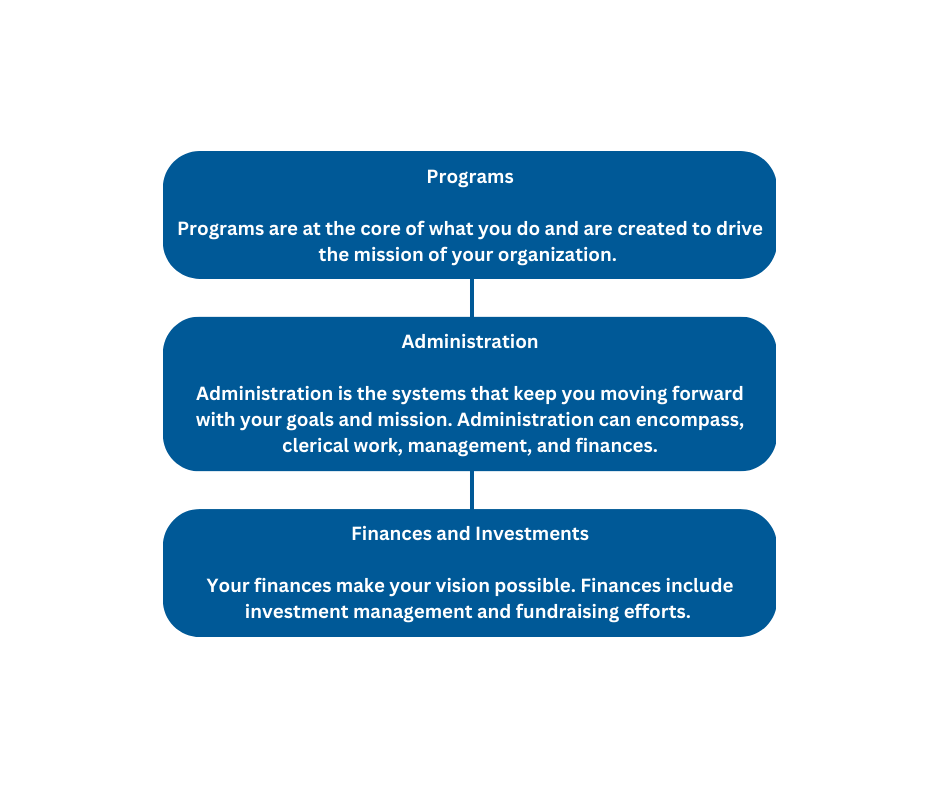
We like to divide functions into 3 buckets: programs, administration/management, and finances. This diagram outlines brief descriptions of these functions. This breakdown makes identifying your needs easier.

How do I identify which roles are necessary to support the functions?

Look at which roles are needed to support each area, starting with Programs. Focus on the role and not the individual person. Building a role for a person means that when they leave the role will cease to exist in the same way and our systems may fail. If we take the time to build a role and place people who are in alignment with the needs of the role, we will be able to fill the role as needed and our systems will remain intact.

How do I identify which systems are needed to support functions?

This is probably the most challenging question and requires interviewing or spending time with the people who work in each area. Here is when you begin to identify things that work, things that don’t, and what the desired workflow should be.

What role does technology play in this process?

Technology is the key to increasing efficiency by reducing the time needed for tasks through automation and reducing the chance of human error. We find that many of our clients struggle with data entry across multiple platforms. Data management is a constant battle. They need strong systems that allow them to access valuable resources and information, but don’t know where to start. In finance and programming, we see issues of human error that are disruptive and detrimental to the goal of the organization. When examining the role of technology, we evaluate how technology may reduce time spent on tasks, reduce human error, enable us to share information efficiently, and most importantly how it will make life easier!

Having a vision for your foundation or public charity is critical. But the vision will never be achievable without the infrastructure to support it and the people who are working every day to make that vision a reality. Dedicate the energy and resources it takes to design and build the infrastructure you, your team, and your organization deserve. You’ll be rewarded with happier staff members and more time to focus on the mission you love.

Patagonia Gift: An Elegant Solution

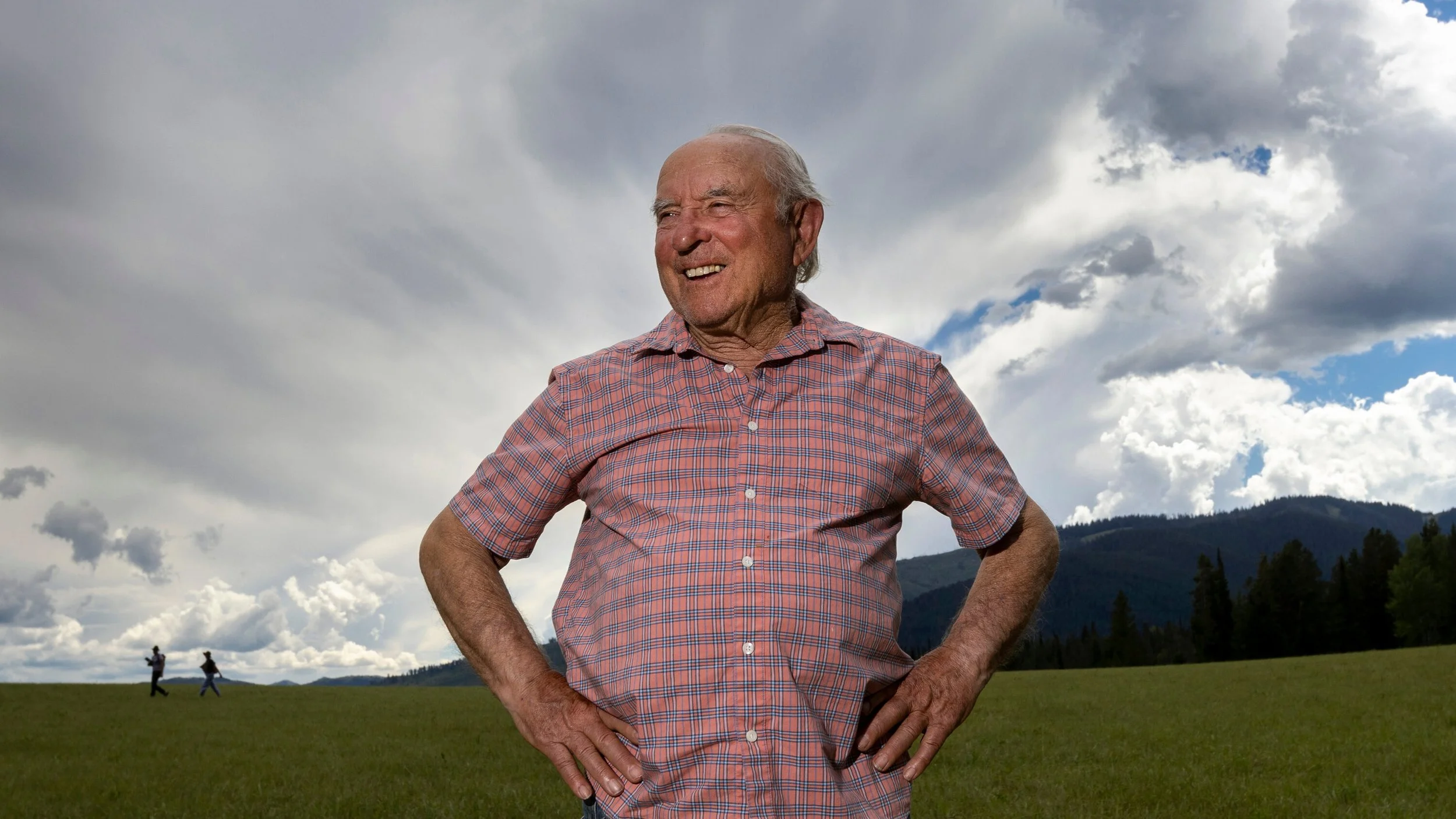
The world was taken by surprise when the owner of Patagonia, Yvon Chouinard decided to give his company away to fight the ongoing climate crisis. Chouinard birthed Patagonia in 1973 from his own deep interest in rock climbing. His decision to have all the profits from the business funneled to trusts and nonprofits dedicated to climate change was not only remarkable but was a decision we as advisors and consultants can all learn from.  

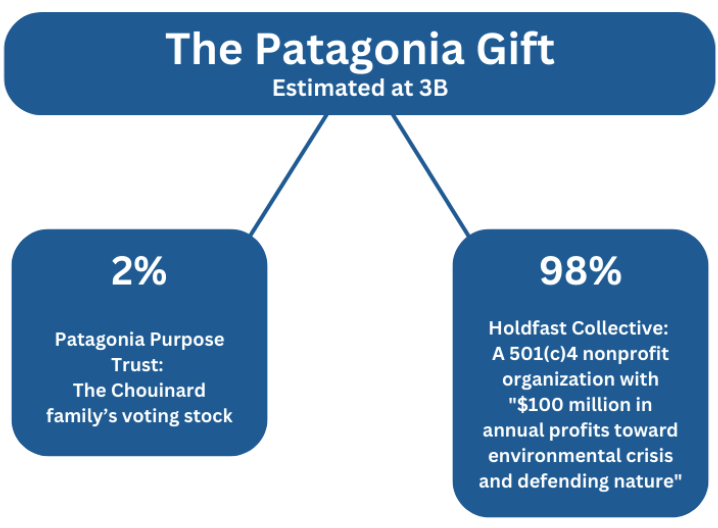
 To understand the weight of these actions, let’s examine what the gift looks like. According to Bloomberg, all shares of Patagonia were worth an estimated 3 billion dollars. Two percent of the company (voting shares held by the family) was donated to the Patagonia Purpose Trust which will maintain control of the corporation. The remaining 98% of the gift are common shares donated to the Holdfast Collective a 501(c)4 nonprofit which due to its status can make both charitable and political contributions. The ability to make these political contributions was clearly a top priority in Chouinard's strategy to fight climate change. However, the donation to Holdfast itself is not eligible for a charitable tax-deductible as it is a 501(c) 4 rather than a 501(c)3. 

The Chouinard family paid an estimated $17.5 million in taxes on this contribution. This is definitely a large sum, but minimal in comparison with the estimated $700 million which would have been due for capital gains taxes had the company been sold.  

As a community of advisors who facilitate gift design, grants and philanthropic efforts, there is frequently a tendency to focus on the creation of a public 501(c)3 or private family foundation. But these vehicles are not always the best solution. In the case of Patagonia, prioritizing the donor’s intention, examining all possibilities and leveraging the power of the 501(c)4’s ability to influence issues via political contributions created an elegant solution when combined with the use of a trust to hold the voting shares (control).  

Dedicating the company to fighting climate change required an intense thought process by experts from various disciplines ranging anywhere from corporate executives to tax exempt organization attorneys. Experts from all fields had to come together to strategically solve Chouinard’s simple directive - to ensure that Patagonia would forever live on to support saving the planet.  

This gift was monumental because of its potential impact current and long- range impact. It powerfully illustrates ways we can disrupt and challenge existing infrastructure and systems through philanthropy.  


So You Received a Gift From a DAF! Here's How to Acknowledge It

So You Received a Gift From a DAF! Here's How to Acknowledge It

We hear from clients all the time with questions about how to acknowledge gifts from Donor Advised Funds (DAFs).

Free DAF Acknowledgement Template included below!

Whether this is your first gift from a DAF, or you’re sending tax receipts for such gifts left and right with a sneaking suspicion your T’s may not be crossed properly, we’ve got you covered. Below are the 5 steps to properly acknowledge a gift from a DAF…